
TOI, TOD, TOR, TOS — Convert
Description
Section titled “Description”The four convert instructions change a value’s data type and write the result to Dest every scan the rung is true. There is one instruction per target type: TOI (To INT), TOD (To DINT), TOR (To REAL) and TOS (To STRING). The source type is read from the operand, so a single instruction parses text or casts a number as needed. They are output instructions with no state and no status bits. Use them to turn a reading into text for a display or a message, to parse a number typed into a STRING, or to move a REAL into a DINT without the silent truncation a MOV would hide in plain sight. Do not use them between numeric types when a MOV already does what you want; MOV converts numbers freely, and the converts earn their place at the boundary with text.
| Mnemonic | Dest type | Text Source | Numeric Source |
|---|---|---|---|
| TOI | INT | Leading whole number is parsed ("42 apples" gives 42, "abc" gives 0) |
Truncated toward zero; wraps past ±32767 |
| TOD | DINT | Same parse | Truncated toward zero; wraps past ±2,147,483,647 |
| TOR | REAL | Leading decimal number is parsed ("3.14bar" gives 3.14) |
Exact for an INT; a DINT keeps about seven digits |
| TOS | STRING | Copied, cut at 15 characters | A whole number prints plain (1450); a REAL prints with four decimals (37.5000) |
Operands
Section titled “Operands”| Operand | Type | Format | Valid Range | Required | Description |
|---|---|---|---|---|---|
| Source | Any atomic tag, member, element or bit, or a literal | Tag, Tag.Member, Tag[n], Tag.bit, a number, or a quoted string |
Any resolvable reference | Yes | The value to convert. |
| Dest | A writable tag, member or element of the target type | Tag, Tag.Member, Tag[n] |
Must match the instruction: INT for TOI, DINT for TOD, REAL for TOR, STRING for TOS | Yes | Where the converted value is written. |
A Dest of the wrong type is a validation error, so the instruction tells you at compile time rather than truncating quietly. A STRING holds 15 characters; a longer result is cut.
Scan Behavior
Section titled “Scan Behavior”Prescan
Section titled “Prescan”Nothing. Dest keeps its power-up value.
Rung-condition-in is false
Section titled “Rung-condition-in is false”The instruction does nothing. Dest holds its last value.
Rung-condition-in is true
Section titled “Rung-condition-in is true”Source is read, converted, and written to Dest every scan the rung is true. Text that does not start with a number converts to 0; nothing faults.
Postscan
Section titled “Postscan”Nothing.
Example
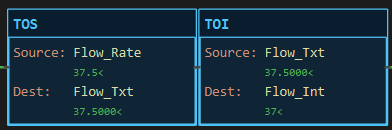
Section titled “Example”Scenario: A flow reading is turned into text for a serial display, and the same text is parsed back to a whole number to show what a display-side parser would receive. Two blocks on one rung, TOS then TOI, so both results appear in one scan.
Tags:
Convert— Run the conversions, BOOLFlow_Rate— Flow in litres per minute, REALFlow_Txt— The reading as text, STRINGFlow_Int— The text parsed back, INT
Rung 1:
—] [Convert———[TOS Flow_Rate Flow_Txt]———[TOI Flow_Txt Flow_Int]———Scan 1 — Convert = 0. Flow_Rate reads 37.5. The rung is false: Flow_Txt is empty and Flow_Int holds 0. An empty STRING paints as a bare < on the block, with nothing before it.

Scan 2 — Convert = 1. TOS writes 37.5000, four decimals because the source is a REAL. TOI then reads that text on the same scan and writes 37: the parse stops at the decimal point.

Replace the TOI with a TOR into a REAL and the text parses back to 37.5.
See Also
Section titled “See Also”- MOV — Move (number to number, text to text)
- CPT — Compute (
TRNtruncates inside an expression) - MSG — Message (where converted text usually goes)
- Move/Logical Instructions — Category index
Four decimals always. TOS on a REAL prints four places whatever the value: 12 becomes 12.0000. Convert through an INT first when a whole number is wanted as text.
Parsing is forgiving. Leading spaces and a sign are accepted; the first character that is not part of a number ends the parse. "12,5" gives 12, not 12.5.
Sixteen-bit limit. TOI of 40000 wraps to −25536 with no warning. Use TOD when the value can exceed 32767.
The block never colours. Watch the rung wire and the Dest value line.
Applies to LadderIDE >=1.2.2 · Last reviewed 2026-09-11 · Screenshots verified 2026-09-11